
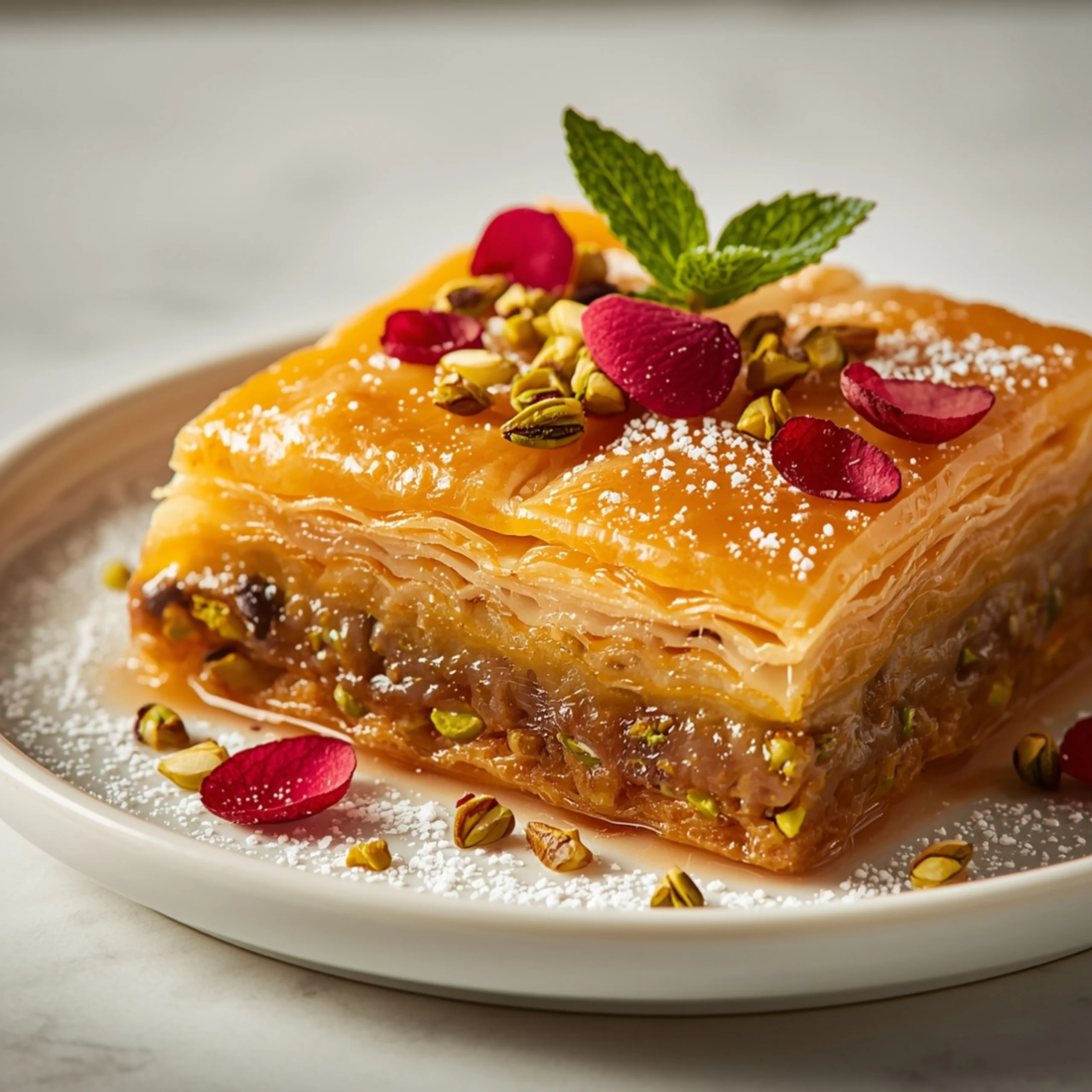
How to Make Flawless Rose & Pistachio Baklava
This Rose & Pistachio Baklava recipe delivers shatteringly crisp phyllo, a rich nut filling, and a fragrant, perfectly balanced syrup. Forget soggy, overly sweet versions; this guide engineers a perfect, bakery-quality result every time. For more show-stopping sweets, explore our full collection of decadent desserts.
The Anatomy of Perfect Baklava
Success with baklava comes down to understanding its four core components. Each plays a critical role in the final texture and flavor.
- Phyllo Dough: The foundation. These paper-thin sheets of unleavened dough, when layered with clarified butter, bake into a light, flaky, and shatteringly crisp structure. The goal is dozens of distinct, audible layers.
- Clarified Butter (Ghee): The lamination agent. Using clarified butter is non-negotiable. It has no milk solids, which means it won’t burn during the long bake time. It provides a pure, nutty flavor and ensures maximum crispness.
- Pistachio Filling: The heart of the baklava. We use coarsely ground raw pistachios for the best texture and flavor. A touch of cardamom and cinnamon adds warmth and complexity, cutting through the richness.
- Rosewater Syrup: The finisher. This isn’t just for sweetness. A properly made syrup, applied at the correct temperature, soaks into the layers without making them soggy. Rosewater provides an intoxicating floral aroma that is the signature of this recipe.
Mastering Phyllo Dough: Pro Tips
Working with phyllo can be intimidating, but it’s manageable with the right technique. It dries out extremely fast when exposed to air.
- Thaw Properly: Thaw frozen phyllo in the refrigerator overnight, still in its package. Never on the counter. Bring it to room temperature for about 1-2 hours before unrolling to prevent cracking.
- The Damp Towel Method: This is the most important tip. Once you unroll the phyllo sheets, immediately cover the stack with a piece of plastic wrap, then a clean, damp (not wet!) kitchen towel. This creates a humid environment and prevents the dough from becoming brittle.
- Work Efficiently: Have all your components ready before you open the phyllo: baking dish buttered, nuts ground, clarified butter melted and ready with a pastry brush.
- Don’t Fear Tears: If a sheet tears as you’re laying it in the pan, don’t panic. The layers are forgiving. Simply patch it up and continue. The middle layers don’t need to be perfect.
Syrup Science: The Key to Crispness
The interaction between the syrup and the pastry is pure food science. The single most important rule is to create a thermal shock. This prevents the baklava from turning into a soggy mess.
- Rule: Hot syrup on cooled baklava. Or, less commonly, cooled syrup on hot-from-the-oven baklava.
- Why it Works: Pouring hot syrup over cooled pastry allows the syrup to be absorbed quickly into the layers without “steaming” them. The phyllo stays crisp. Pouring cool syrup over hot pastry works similarly, but the hot-on-cool method provides slightly better absorption.
- Don’t Stir! Once the sugar dissolves and the syrup comes to a boil, do not stir it. Stirring can encourage sugar crystals to form, resulting in a grainy syrup. You can gently swirl the pan if needed.
STEP-BY-STEP INSTRUCTIONS
Prep Time: 45 mins | Cook Time: 50-60 mins | Rest Time: 4-6 hours
Phase 1: Prepare the Components
- Make the Syrup: In a medium saucepan, combine the sugar, water, and lemon juice. Bring to a medium boil, then reduce heat and simmer for 10-12 minutes, until it slightly thickens (it should coat the back of a spoon). Remove from heat and stir in the rosewater. Let it cool completely.
- Clarify the Butter: Melt the unsalted butter in a small saucepan over low heat. Skim the white milk solids from the top. Carefully pour the clear golden butterfat into a bowl, leaving the remaining milk solids at the bottom of the pan. You should have about 1 cup of clarified butter.
- Prepare the Filling: In a food processor, pulse the raw pistachios until they are coarsely ground—the size of coarse breadcrumbs. Do not over-process into a paste. Transfer to a bowl and mix with the ground cardamom and cinnamon.
- Set Up Your Station: Preheat your oven to 350°F (175°C). Have your 9×13 inch baking pan, thawed phyllo (covered with plastic wrap and a damp towel), bowl of clarified butter with a pastry brush, and nut mixture ready to go.
Phase 2: Assemble the Baklava
- Bottom Layers: Brush the bottom and sides of your baking pan with clarified butter. Lay one sheet of phyllo in the pan, letting any excess hang over the sides (you’ll trim it later). Brush the entire sheet generously with clarified butter. Repeat this for a total of 10 sheets, brushing each one.
- First Nut Layer: Sprinkle about half of the pistachio mixture evenly over the 10th phyllo sheet.
- Middle Layers: Layer 6 more phyllo sheets on top of the nuts, brushing each one with butter.
- Second Nut Layer: Sprinkle the remaining half of the pistachio mixture over the top.
- Top Layers: Layer the final 10-12 phyllo sheets, brushing each one meticulously with butter. The top layer should be perfectly brushed for a golden, glossy finish.
- Trim and Score: Tuck the overhanging edges of phyllo down into the pan or trim them flush with a sharp knife. Using a very sharp knife, carefully cut the baklava into diamond or square shapes, making sure to cut all the way through to the bottom. This is crucial for the syrup to penetrate.
Phase 3: Bake and Finish
- Bake: Place the pan in the preheated oven and bake for 50-60 minutes, or until the top is a deep golden brown and sounds crisp when you tap it.
- Cool Slightly: Remove the baklava from the oven and let it cool on a wire rack for at least 15-20 minutes.
- Apply Syrup: Slowly and evenly pour the completely cooled syrup over the warm (not hot) baklava. You will hear a satisfying sizzle.
- Garnish & Rest: Sprinkle the top with crushed pistachios and dried rose petals.
- Rest (Crucial): Let the baklava sit uncovered at room temperature for at least 4-6 hours, or preferably overnight. This allows the syrup to fully absorb and the layers to set, achieving the perfect texture. Do not cover it, as this will trap steam and make it soggy.
Make-Ahead & Storage Guide
Baklava is the perfect make-ahead dessert, as its flavor deepens and texture improves after a day. It is a fantastic finale for a dinner party, freeing you up to focus on the main event. If you need ideas for that, we have a great selection of dinner recipes to get you started.
- To Store: Store the finished baklava in an airtight container at room temperature. It does not need to be refrigerated. Refrigeration can crystallize the syrup and soften the phyllo. It will keep well for up to one week.
- To Freeze (Unbaked): You can assemble the entire baklava, cut it, and freeze it (unbaked) for up to 2 months. Do not pour the syrup on. Wrap the pan tightly in multiple layers of plastic wrap and foil. Bake directly from frozen, adding 15-20 minutes to the baking time. Pour cooled syrup over the hot baklava.
- To Freeze (Baked): You can also freeze baked and syruped baklava. Let it cool completely, then wrap tightly and freeze. Thaw uncovered at room temperature.
COMMON MISTAKES TO AVOID
- Mistake: Soggy or soft baklava.
Fix: Ensure a significant temperature difference between the syrup and the pastry. Pour cool syrup over warm baklava. Also, never cover baklava while it’s cooling or storing, as trapped steam is the enemy of crispness. - Mistake: The top layers of phyllo curl up or fly away during baking.
Fix: You didn’t use enough butter. Be generous with the clarified butter on every single layer, especially the final top sheet. The butter acts as a glue and weighs the sheets down. - Mistake: The phyllo dough becomes dry and cracks while working with it.
Fix: The dough was exposed to air for too long. Keep the stack of phyllo you’re not actively using covered with plastic wrap and a damp towel at all times.
FAQ
Q: Can I use different nuts?
A: Absolutely. Walnuts are the most common alternative. Almonds or a mix of walnuts and pistachios also work beautifully. The process remains the same.
Q: Why do I have to use clarified butter?
A: Regular melted butter contains water and milk solids. The water content can create steam and make the phyllo soggy, while the milk solids can burn during the long baking time, creating a bitter taste and dark spots. Clarified butter is pure fat, ensuring a nutty flavor and maximum crispness.
Q: My syrup turned into a hard, sugary crystal. What went wrong?
A: You likely stirred it after it came to a boil, or you may have had a sugar crystal on the side of your pot that fell in. A small amount of acid (the lemon juice in this recipe) helps prevent crystallization. To fix a grainy syrup, you can gently reheat it with a tablespoon of water, without stirring, until the crystals dissolve.
While the complex floral and nutty notes of this baklava are a true delicacy, sometimes the palate craves a simpler, more direct flavor combination. For a completely different but equally satisfying experience, food explorers at Meaty Delights have experimented with profiles like their fried egg yolk, burrata, and prosciutto toast, showcasing a unique savory-sweet balance. If you are looking for another fantastic dessert idea, consider this Black Forest Trifle for a rich, chocolatey alternative.
NUTRITIONAL SNAPSHOT
| Nutrient | Amount per Serving |
|---|---|
| Calories | 380 kcal |
| Protein | 5g |
| Fat | 24g |
| Net Carbs | 35g |
| Fiber | 2g |
| Sugar | 22g |
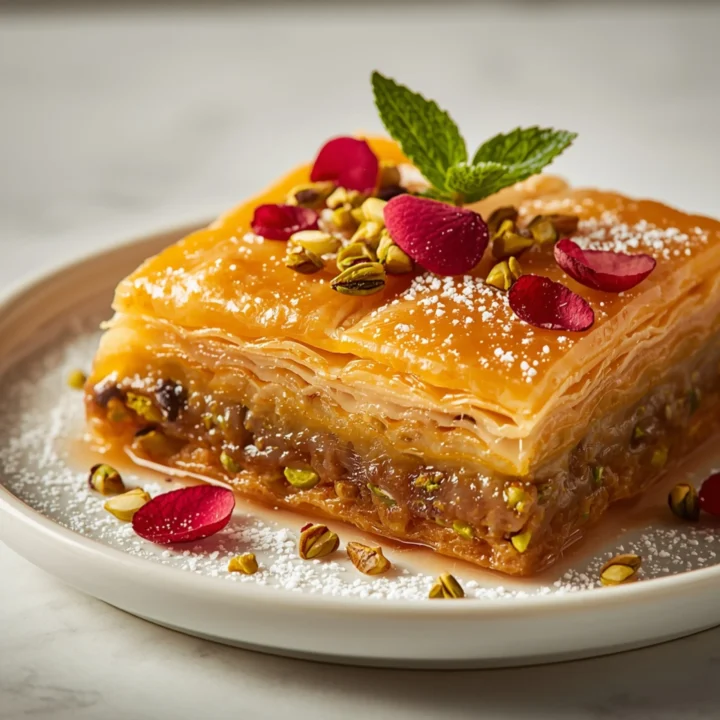
How to Make Flawless Rose & Pistachio Baklava
This Rose & Pistachio Baklava recipe delivers shatteringly crisp phyllo, a rich nut filling, and a fragrant, perfectly balanced syrup. Forget soggy, overly sweet versions; this guide engineers a perfect, bakery-quality result every time.
Ingredients
- 1 lb (454g) phyllo dough (about 40 sheets), thawed
- 1 1/2 cups (340g) unsalted butter, for clarifying
- 3 cups (360g) raw, unsalted pistachios
- 1 tsp ground cardamom
- 1/2 tsp ground cinnamon
- 2 cups (400g) granulated sugar
- 1 cup (240ml) water
- 1 tbsp fresh lemon juice
- 1 1/2 tbsp rosewater
- 1/4 cup finely chopped pistachios
- 1 tbsp dried edible rose petals (optional)
Instructions
- Make the Syrup: In a medium saucepan, combine the sugar, water, and lemon juice. Bring to a medium boil, then reduce heat and simmer for 10-12 minutes, until it slightly thickens (it should coat the back of a spoon). Remove from heat and stir in the rosewater. Let it cool completely.
- Clarify the Butter: Melt the unsalted butter in a small saucepan over low heat. Skim the white milk solids from the top. Carefully pour the clear golden butterfat into a bowl, leaving the remaining milk solids at the bottom of the pan. You should have about 1 cup of clarified butter.
- Prepare the Filling: In a food processor, pulse the raw pistachios until they are coarsely ground—the size of coarse breadcrumbs. Do not over-process into a paste. Transfer to a bowl and mix with the ground cardamom and cinnamon.
- Set Up Your Station: Preheat your oven to 350°F (175°C). Have your 9x13 inch baking pan, thawed phyllo (covered with plastic wrap and a damp towel), bowl of clarified butter with a pastry brush, and nut mixture ready to go.
- Bottom Layers: Brush the bottom and sides of your baking pan with clarified butter. Lay one sheet of phyllo in the pan, letting any excess hang over the sides (you'll trim it later). Brush the entire sheet generously with clarified butter. Repeat this for a total of 10 sheets, brushing each one.
- First Nut Layer: Sprinkle about half of the pistachio mixture evenly over the 10th phyllo sheet.
- Middle Layers: Layer 6 more phyllo sheets on top of the nuts, brushing each one with butter.
- Second Nut Layer: Sprinkle the remaining half of the pistachio mixture over the top.
- Top Layers: Layer the final 10-12 phyllo sheets, brushing each one meticulously with butter. The top layer should be perfectly brushed for a golden, glossy finish.
- Trim and Score: Tuck the overhanging edges of phyllo down into the pan or trim them flush with a sharp knife. Using a very sharp knife, carefully cut the baklava into diamond or square shapes, making sure to cut all the way through to the bottom. This is crucial for the syrup to penetrate.
- Bake: Place the pan in the preheated oven and bake for 50-60 minutes, or until the top is a deep golden brown and sounds crisp when you tap it.
- Cool Slightly: Remove the baklava from the oven and let it cool on a wire rack for at least 15-20 minutes.
- Apply Syrup: Slowly and evenly pour the completely cooled syrup over the warm (not hot) baklava. You will hear a satisfying sizzle.
- Garnish & Rest: Sprinkle the top with crushed pistachios and dried rose petals.
- Rest (Crucial): Let the baklava sit uncovered at room temperature for at least 4-6 hours, or preferably overnight. This allows the syrup to fully absorb and the layers to set, achieving the perfect texture. Do not cover it, as this will trap steam and make it soggy.