
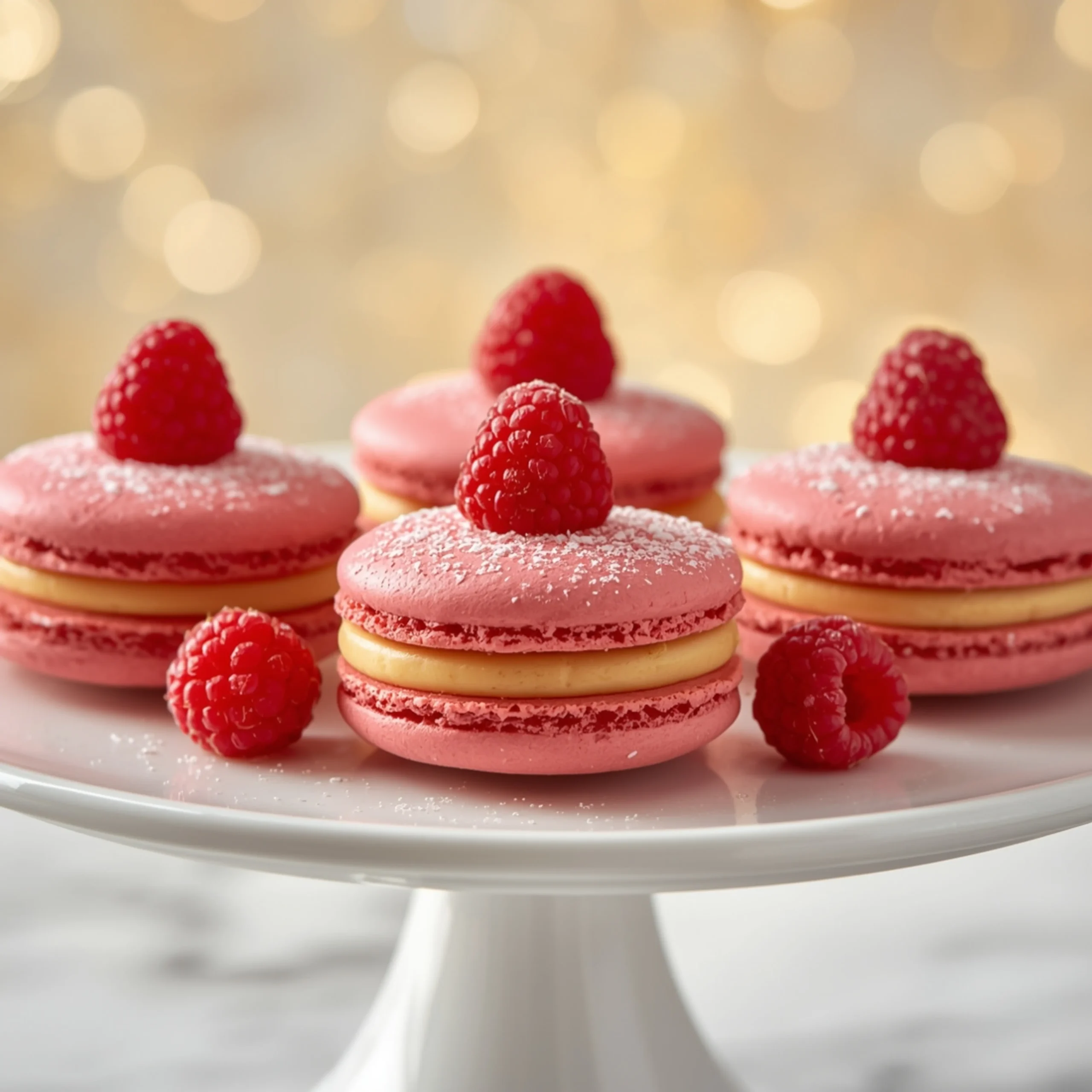
A Foolproof Guide to Raspberry Pistachio Macarons
These luxurious Raspberry Pistachio Macarons feature crisp shells, a chewy interior, and a vibrant, perfectly balanced filling. This guide uses the Italian meringue method—a stable, reliable technique that delivers flawless results. They’re a stunning addition to my collection of favorite dessert recipes.
The Macaronage Blueprint: Why This Method Works
Macarons have a reputation for being finicky, but understanding the engineering behind them demystifies the process. This recipe relies on a few key principles for consistency.
- Italian Meringue: We use a hot sugar syrup to cook the egg whites. This creates an incredibly stable meringue that is less prone to collapsing, making it more forgiving than the French method. It’s the professional’s choice for a reason.
- Precise Measurements: Volume (cups) is unreliable for baking. A digital kitchen scale is non-negotiable. Macarons are a science; treat your ingredients like chemical reagents.
- The “Lava” Stage: The “macaronage” (folding the dry ingredients into the meringue) is the most critical step. You’re looking for a batter that flows from the spatula in a continuous, ribbon-like stream, often described as “like slow-moving lava.”
Essential Equipment Checklist
Proper tools are half the battle. Don’t substitute these items.
- Digital Kitchen Scale: For mandatory gram-perfect accuracy.
- Stand Mixer: Essential for stabilizing the Italian meringue while you pour hot sugar syrup.
- Candy Thermometer: Crucial for hitting the exact sugar syrup temperature (244°F / 118°C).
- Piping Bag with a Round Tip: A ½-inch (1 cm) round tip ensures uniform shells.
- Silicone Baking Mats or Parchment Paper: A non-stick surface is key. Many mats come with pre-printed circles for consistency.
- Fine-Mesh Sieve: To remove any lumps from the almond flour and powdered sugar for a silky-smooth shell.
Flavor Architecture: Balancing Raspberry & Pistachio
The success of these macarons lies in the quality and balance of their two star ingredients. Just like in many of my other favorite recipes, ingredient sourcing is paramount.
- For the Pistachio Shells: Use finely ground almond flour and unsalted, raw pistachio flour/meal. You can make your own by blitzing raw pistachios in a food processor, but be careful not to over-process it into a paste. Sift thoroughly.
- For the Raspberry Filling: Use freeze-dried raspberry powder. Do not use fresh raspberry purée or jam inside the buttercream; the high water content will make the shells soggy. The powder provides intense, concentrated flavor without compromising texture. A little high-quality raspberry extract can also boost the flavor.
Step-by-Step Instructions
Preparation is key. Measure all ingredients before you begin. Wipe down your mixer bowl and whisk with a little white vinegar to remove any traces of fat, which can deflate your meringue.
Part 1: The Pistachio Macaron Shells
- Sift Dry Ingredients: In a medium bowl, sift the almond flour, pistachio flour, and powdered sugar together twice. This aerates the mixture and removes lumps. Set aside.
- Make the Almond Paste: Add the first portion of egg whites (55g) to the dry ingredients. Mix with a spatula until a thick, uniform paste forms. Set aside.
- Prepare the Meringue: In the clean bowl of a stand mixer fitted with a whisk attachment, add the second portion of egg whites (55g).
- Cook the Sugar Syrup: In a small saucepan, combine the granulated sugar and water. Bring to a boil over medium-high heat, using a candy thermometer to monitor the temperature.
- Whip the Egg Whites: When the syrup reaches 230°F (110°C), begin whipping the egg whites on medium speed until they form soft peaks.
- Combine Syrup and Meringue: Once the syrup reaches exactly 244°F (118°C), immediately remove it from the heat. With the mixer running on medium-low, carefully and slowly pour the hot syrup in a thin stream down the side of the bowl. Avoid hitting the whisk.
- Whip to Stiff Peaks: Once all the syrup is added, increase the mixer speed to medium-high. Whip until the meringue is glossy, thick, and the outside of the bowl is warm to the touch (not hot). This can take 5-10 minutes.
- Macaronage: Add one-third of the meringue to the almond paste and mix vigorously to lighten the paste. Gently fold in the remaining meringue in two additions. Fold by scraping around the bowl and cutting through the middle. Stop when the batter flows off the spatula in a continuous ribbon.
- Pipe the Shells: Transfer the batter to a piping bag with a round tip. Pipe 1.5-inch (3-4 cm) circles onto baking sheets lined with silicone mats or parchment paper, leaving space between them.
- Rest the Shells: Firmly tap the baking sheets on the counter a few times to release air bubbles. Let the shells rest at room temperature for 30-60 minutes, or until they form a dry, non-tacky “skin.” This is crucial for developing “feet.” Preheat your oven to 320°F (160°C) during this time.
- Bake: Bake one sheet at a time for 12-15 minutes, rotating halfway through. The macarons are done when the tops are firm and the feet don’t wobble when gently touched.
- Cool: Let the shells cool completely on the baking sheet before attempting to remove them.
Part 2: The Raspberry Buttercream Filling
- Cream Butter: In a bowl, beat the softened butter with a hand mixer or stand mixer until it’s light and fluffy (about 2-3 minutes).
- Add Sugar and Raspberry: Add the powdered sugar and freeze-dried raspberry powder. Mix on low speed until combined, then increase to medium-high and beat for another 3 minutes until smooth.
- Finish: Add the heavy cream and vanilla extract, mixing until just combined.
Part 3: Assembly & Maturation
- Pair Shells: Match up macaron shells by size.
- Fill: Pipe a small dollop of raspberry buttercream onto the flat side of one shell and gently press another shell on top.
- Mature (Crucial Step): Place the filled macarons in an airtight container in the refrigerator for at least 24 hours. This “maturation” step allows the filling to soften the inside of the shell, creating the signature chewy texture. After an elegant dessert like this, you might be curious about richer options, and for that, exploring something like chocolate chip pecan pie bars could be a great next bake.
COMMON MISTAKES TO AVOID
- Mistake: Hollow Shells.
- Fix: This is usually caused by over-mixing the batter (macaronage) or under-baking. Ensure your meringue is stiff and fold only until the “lava” stage is reached. Bake until the shells are firm.
- Mistake: Cracked Tops.
- Fix: You didn’t rest the shells long enough. The “skin” that forms during resting is what prevents cracking and forces the macaron to rise upwards, creating feet. Don’t rush this step.
- Mistake: No “Feet” (the ruffled edge at the bottom).
- Fix: The meringue was likely under-whipped, or the batter was too wet/runny. Whip the meringue until it’s very stiff and glossy. Ensure your almond flour isn’t oily.
FAQ
Q: Can I use regular food coloring?
A: It’s not recommended. Liquid food coloring adds too much moisture. Use gel or powdered food coloring for the best results, adding it to the meringue after it has reached stiff peaks.
Q: Why do my macarons look blotchy or oily?
A: This is almost always a result of oily almond flour. Either the brand is poor quality, or it was over-processed. Stick to fine-milled, high-quality brands.
Q: How do I store finished macarons?
A: Store them in an airtight container in the refrigerator for up to 5 days or in the freezer for up to a month. They are best served at room temperature, so let them sit out for 20 minutes before enjoying.
NUTRITIONAL SNAPSHOT
| Nutrient | Amount per Serving |
|---|---|
| Calories | 115 kcal |
| Protein | 2g |
| Fat | 7g |
| Net Carbs | 11g |
| Fiber | 1g |
| Sugar | 10g |
While these macarons are a perfect light dessert after any meal, sometimes you need a savory start to your day. For those occasions, a hearty dish like a cheesy baked egg casserole recipe can be incredibly satisfying.
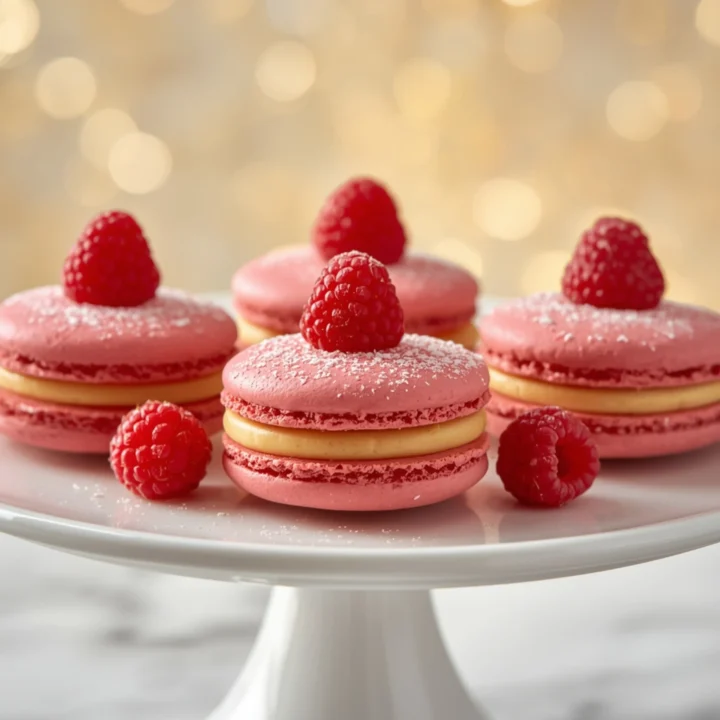
A Foolproof Guide to Raspberry Pistachio Macarons
These luxurious Raspberry Pistachio Macarons feature crisp shells, a chewy interior, and a vibrant, perfectly balanced filling. This guide uses the Italian meringue method—a stable, reliable technique that delivers flawless results.
Ingredients
- 110g Almond Flour
- 40g Pistachio Flour (finely ground raw pistachios)
- 150g Powdered Sugar
- 55g Egg Whites (aged or fresh), at room temperature (Portion 1)
- 150g Granulated Sugar
- 40g Water
- 55g Egg Whites (aged or fresh), at room temperature (Portion 2)
- 1/2 cup (113g) Unsalted Butter, softened
- 1.5 cups (180g) Powdered Sugar
- 3 tbsp Freeze-Dried Raspberry Powder
- 1 tbsp Heavy Cream or Milk
- 1/2 tsp Vanilla Extract
Instructions
- Preparation is key. Measure all ingredients before you begin. Wipe down your mixer bowl and whisk with a little white vinegar to remove any traces of fat, which can deflate your meringue.
- In a medium bowl, sift the almond flour, pistachio flour, and powdered sugar together twice. This aerates the mixture and removes lumps. Set aside.
- Add the first portion of egg whites (55g) to the dry ingredients. Mix with a spatula until a thick, uniform paste forms. Set aside.
- In the clean bowl of a stand mixer fitted with a whisk attachment, add the second portion of egg whites (55g).
- In a small saucepan, combine the granulated sugar and water. Bring to a boil over medium-high heat, using a candy thermometer to monitor the temperature.
- When the syrup reaches 230°F (110°C), begin whipping the egg whites on medium speed until they form soft peaks.
- Once the syrup reaches exactly 244°F (118°C), immediately remove it from the heat. With the mixer running on medium-low, carefully and slowly pour the hot syrup in a thin stream down the side of the bowl. Avoid hitting the whisk.
- Once all the syrup is added, increase the mixer speed to medium-high. Whip until the meringue is glossy, thick, and the outside of the bowl is warm to the touch (not hot). This can take 5-10 minutes.
- Add one-third of the meringue to the almond paste and mix vigorously to lighten the paste. Gently fold in the remaining meringue in two additions. Fold by scraping around the bowl and cutting through the middle. Stop when the batter flows off the spatula in a continuous ribbon.
- Transfer the batter to a piping bag with a round tip. Pipe 1.5-inch (3-4 cm) circles onto baking sheets lined with silicone mats or parchment paper, leaving space between them.
- Firmly tap the baking sheets on the counter a few times to release air bubbles. Let the shells rest at room temperature for 30-60 minutes, or until they form a dry, non-tacky "skin." This is crucial for developing "feet." Preheat your oven to 320°F (160°C) during this time.
- Bake one sheet at a time for 12-15 minutes, rotating halfway through. The macarons are done when the tops are firm and the feet don't wobble when gently touched.
- Let the shells cool completely on the baking sheet before attempting to remove them.
- In a bowl, beat the softened butter with a hand mixer or stand mixer until it's light and fluffy (about 2-3 minutes).
- Add the powdered sugar and freeze-dried raspberry powder. Mix on low speed until combined, then increase to medium-high and beat for another 3 minutes until smooth.
- Add the heavy cream and vanilla extract, mixing until just combined.
- Match up macaron shells by size.
- Pipe a small dollop of raspberry buttercream onto the flat side of one shell and gently press another shell on top.
- Place the filled macarons in an airtight container in the refrigerator for at least 24 hours. This "maturation" step allows the filling to soften the inside of the shell, creating the signature chewy texture.