
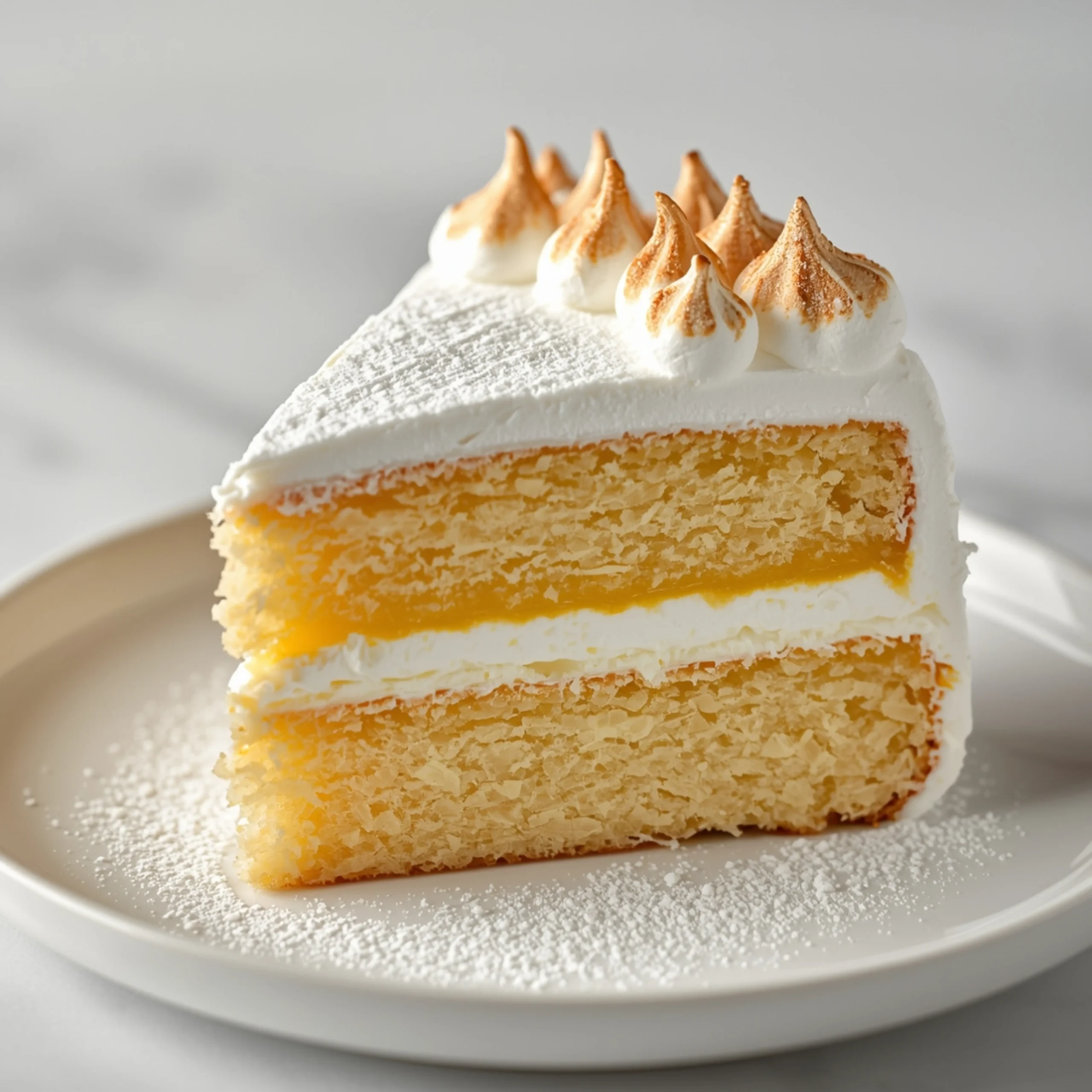
A Bright & Airy Lemon Meringue Layer Cake Recipe
This stunning cake transforms the classic pie into a showstopping centerpiece. It balances tangy lemon curd, fluffy vanilla cake, and a billowy, toasted meringue frosting for a truly unforgettable dessert. It’s one of the most rewarding bakes in my entire collection of desserts.
The Core Components: Cake, Curd, & Meringue
A perfect Lemon Meringue Layer Cake is a symphony of three distinct elements working in harmony. Mastering each one is the key to success.
- The Cake: We use a reverse-creamed vanilla sponge. This method creates a tender, fine, and sturdy crumb that can handle the weight of the curd and meringue without becoming dense. It’s the stable foundation.
- The Curd: This is where the intense lemon flavor comes from. Our curd is thick, glossy, and intensely tart to cut through the sweetness of the other layers. Using both juice and zest is non-negotiable for maximum impact.
- The Meringue: We use a Swiss Meringue. It’s incredibly stable, glossy, and safe to eat without further baking. It toasts beautifully with a kitchen torch, creating that iconic campfire-marshmallow flavor and texture.
Meringue Deep Dive: The Swiss Method
Many recipes use Italian meringue, but the Swiss method is more direct for the home cook.
Why Swiss Meringue Works:
- Stability: By gently heating the egg whites and sugar over a double boiler, you dissolve the sugar completely and create a very strong, stable protein network.
- Safety: The mixture is heated to 160°F (71°C), which pasteurizes the egg whites, making them safe to consume.
- Texture: The result is a dense, glossy, and smooth meringue that holds its shape perfectly for piping, spreading, and toasting. It’s less prone to weeping than a simple French meringue.
Mastering techniques like this is a rewarding part of exploring new recipes. While this lemon cake is bright and zesty, for a richer, holiday-themed dessert, a decadent Peppermint Bark Cheesecake offers a completely different but equally delicious challenge.
Step-by-Step Instructions
Part 1: The Lemon Curd (Do this first)
- Whisk Ingredients: In a medium saucepan, whisk together the egg yolks, granulated sugar, lemon juice, and lemon zest.
- Cook Gently: Place the saucepan over medium-low heat. Whisk constantly to prevent scrambling. The mixture will slowly thicken.
- Thicken to Coat: Continue cooking and whisking for 6-8 minutes, until the curd is thick enough to coat the back of a spoon. Do not let it boil.
- Add Butter: Remove from heat and stir in the cold, cubed butter one piece at a time until fully melted and incorporated.
- Strain & Chill: Pour the curd through a fine-mesh sieve into a bowl to remove any zest or cooked egg bits. Press a piece of plastic wrap directly onto the surface of the curd to prevent a skin from forming. Chill in the refrigerator for at least 4 hours, or until completely cold and set.
Part 2: The Vanilla Cake Layers
- Prep: Preheat your oven to 350°F (175°C). Grease and flour two 8-inch round cake pans and line the bottoms with parchment paper.
- Combine Dry Ingredients: In a large bowl, whisk together the flour, sugar, baking powder, and salt.
- Add Butter: Add the softened butter cubes to the dry ingredients. Using a stand mixer with the paddle attachment or a hand mixer, mix on low speed until the mixture resembles coarse, damp sand.
- Combine Wet Ingredients: In a separate bowl, whisk together the egg whites, milk, and vanilla extract.
- Mix Batter: Pour half of the wet ingredients into the flour mixture and mix on medium speed for 90 seconds. Scrape down the bowl. Add the remaining wet ingredients and mix for another 30 seconds until just combined. Do not overmix.
- Bake: Divide the batter evenly between the two prepared pans. Bake for 30-35 minutes, or until a toothpick inserted into the center comes out clean.
- Cool: Let the cakes cool in the pans for 10 minutes before inverting them onto a wire rack to cool completely.
Part 3: The Swiss Meringue Frosting & Assembly
- Set Up Double Boiler: Fill a medium saucepan with about 1-2 inches of water and bring it to a simmer.
- Heat Whites & Sugar: In the heatproof bowl of your stand mixer, whisk together the egg whites and granulated sugar. Place the bowl over the simmering water (ensure the bottom of the bowl doesn’t touch the water).
- Dissolve Sugar: Whisk constantly until the sugar has completely dissolved and the mixture is hot to the touch (160°F / 71°C on an instant-read thermometer).
- Whip Meringue: Carefully transfer the bowl to your stand mixer fitted with the whisk attachment. Start on low speed and gradually increase to high. Whip for 8-10 minutes, until the meringue is thick, glossy, and has formed stiff peaks. The outside of the bowl should feel cool to the touch. Mix in the vanilla extract.
- Assemble the Cake: Place one cake layer on your serving plate. Pipe a tall border of meringue around the top edge to create a dam.
- Fill: Spoon half of the chilled lemon curd into the center of the meringue dam and spread it evenly.
- Layer: Carefully place the second cake layer on top. Cover the entire cake—top and sides—with the remaining Swiss meringue, creating decorative swoops and peaks with an offset spatula.
- Toast: Using a kitchen torch, carefully toast the meringue peaks until they are golden brown. Serve immediately or chill until ready.
Make-Ahead & Storage Guide
Proper planning prevents last-minute stress. This cake is ideal for making in stages.
- Lemon Curd: Can be made up to 3 days in advance. Keep it in an airtight container in the refrigerator with plastic wrap pressed against the surface.
- Cake Layers: Can be baked 1 day in advance. Once completely cool, wrap them tightly in plastic wrap and store at room temperature.
- Assembly: The cake is best assembled and toasted on the day of serving. The meringue is at its best when fresh.
- Leftovers: Store leftover cake in the refrigerator for up to 2 days. The meringue may weep slightly over time, but the flavor will still be excellent.
COMMON MISTAKES TO AVOID
- Mistake: Runny lemon curd.
- Fix: You didn’t cook it long enough. The curd needs to be noticeably thick and coat a spoon before you remove it from the heat. Whisk constantly over gentle heat to ensure it thickens properly without scrambling the eggs.
- Mistake: Weeping meringue.
- Fix: The sugar was not fully dissolved. When heating your egg whites and sugar, rub a small amount of the mixture between your fingers. If it feels grainy, keep whisking over the heat until it’s perfectly smooth.
- Mistake: A dense, heavy cake.
- Fix: Over-mixing the batter after adding the final portion of wet ingredients. Once the flour is hydrated, mixing develops gluten. Mix only until the last streaks of flour disappear for a tender crumb.
FAQ
Q: Can I use store-bought lemon curd?
A: Yes, you can in a pinch. However, homemade curd provides a much brighter, tarter flavor that is essential for balancing the cake’s sweetness. Homemade is worth the small effort.
Q: My meringue deflated. What happened?
A: This is almost always caused by a trace of fat. Ensure your mixing bowl, whisk, and utensils are perfectly clean and free of any grease. Even a tiny speck of egg yolk in your whites can prevent them from whipping to full volume.
Q: Can I serve this after a big meal?
A: Absolutely. Its bright, acidic flavor is a perfect palate cleanser after a rich main course, such as a classic Roast Turkey with Garlic-Herb Butter, making it an ideal choice for holiday dinners.
NUTRITIONAL SNAPSHOT
| Nutrient | Amount per Serving |
|---|---|
| Calories | 580 kcal |
| Protein | 8g |
| Fat | 26g |
| Net Carbs | 78g |
| Fiber | 1g |
| Sugar | 65g |
*Estimates are for one slice (1/12th of the cake).*

A Bright & Airy Lemon Meringue Layer Cake Recipe
This stunning cake transforms the classic pie into a showstopping centerpiece. It balances tangy lemon curd, fluffy vanilla cake, and a billowy, toasted meringue frosting for a truly unforgettable dessert. It's one of the most rewarding bakes in my entire collection of desserts.
Ingredients
- 6 large egg yolks
- 1 cup (200g) granulated sugar
- 1/2 cup (120ml) fresh lemon juice (from 3-4 lemons)
- 1 tablespoon finely grated lemon zest
- 1/2 cup (113g) unsalted butter, cold and cubed
- 2 1/2 cups (300g) all-purpose flour
- 1 3/4 cups (350g) granulated sugar
- 1 tablespoon baking powder
- 1 teaspoon salt
- 3/4 cup (170g) unsalted butter, softened and cubed
- 4 large egg whites, room temperature
- 1 cup (240ml) whole milk, room temperature
- 2 teaspoons vanilla extract
- 5 large egg whites
- 1 1/2 cups (300g) granulated sugar
- 1/4 teaspoon cream of tartar (optional, for stability)
- 1 teaspoon vanilla extract
Instructions
- In a medium saucepan, whisk together the egg yolks, granulated sugar, lemon juice, and lemon zest.
- Place the saucepan over medium-low heat. Whisk constantly to prevent scrambling. The mixture will slowly thicken.
- Continue cooking and whisking for 6-8 minutes, until the curd is thick enough to coat the back of a spoon. Do not let it boil.
- Remove from heat and stir in the cold, cubed butter one piece at a time until fully melted and incorporated.
- Pour the curd through a fine-mesh sieve into a bowl to remove any zest or cooked egg bits. Press a piece of plastic wrap directly onto the surface of the curd to prevent a skin from forming. Chill in the refrigerator for at least 4 hours, or until completely cold and set.
- Preheat your oven to 350°F (175°C). Grease and flour two 8-inch round cake pans and line the bottoms with parchment paper.
- In a large bowl, whisk together the flour, sugar, baking powder, and salt.
- Add the softened butter cubes to the dry ingredients. Using a stand mixer with the paddle attachment or a hand mixer, mix on low speed until the mixture resembles coarse, damp sand.
- In a separate bowl, whisk together the egg whites, milk, and vanilla extract.
- Pour half of the wet ingredients into the flour mixture and mix on medium speed for 90 seconds. Scrape down the bowl. Add the remaining wet ingredients and mix for another 30 seconds until just combined. Do not overmix.
- Divide the batter evenly between the two prepared pans. Bake for 30-35 minutes, or until a toothpick inserted into the center comes out clean.
- Let the cakes cool in the pans for 10 minutes before inverting them onto a wire rack to cool completely.
- Fill a medium saucepan with about 1-2 inches of water and bring it to a simmer.
- In the heatproof bowl of your stand mixer, whisk together the egg whites and granulated sugar. Place the bowl over the simmering water (ensure the bottom of the bowl doesn't touch the water).
- Whisk constantly until the sugar has completely dissolved and the mixture is hot to the touch (160°F / 71°C on an instant-read thermometer).
- Carefully transfer the bowl to your stand mixer fitted with the whisk attachment. Start on low speed and gradually increase to high. Whip for 8-10 minutes, until the meringue is thick, glossy, and has formed stiff peaks. The outside of the bowl should feel cool to the touch. Mix in the vanilla extract.
- Place one cake layer on your serving plate. Pipe a tall border of meringue around the top edge to create a dam.
- Spoon half of the chilled lemon curd into the center of the meringue dam and spread it evenly.
- Carefully place the second cake layer on top. Cover the entire cake—top and sides—with the remaining Swiss meringue, creating decorative swoops and peaks with an offset spatula.
- Using a kitchen torch, carefully toast the meringue peaks until they are golden brown. Serve immediately or chill until ready.